Hello! Friends, how are you! Hope you all are fine. In these days of lockdown how we generate wealth and learn stock market trading, in this article we will talking about financial market,stock exchange i.e,'NSE / BSE, SEBI, DEMAT Account. and the link of opening dmat a/c is given below of Upstox Broker,"India's leading and fastest growing Stock broker in the Market.


Hey there! I have been investing in stocks and mutual funds using the Upstox platform and am quite impressed! Upstox offers free equity delivery trades and you pay only up to Rs. 20 per order for Intraday, Futures and Options and Currencies and Commodities. You get one of the best margins in the industry and access to a wide range of technical indicators and drawing tools. Join one of India’s fastest-growing broker.
Meaning of Stock Exchange
Stock exchange is a platform where dealings take place in shares, debentures and bonds issued
by the private sector companies, public enterprises , government etc. Such shares, debentures and bonds are called securities. Only those securities could be traded that are included in the
official list of stock exchange. The Securities Contracts (Regulations) Act, 1956 has defined
stock exchange as an association, organisation or body of individuals, whether incorporated or
not, established for the purpose of assisting, regulating and controlling business in buying, selling
and dealing in securities.
Stock exchange is also called stock market or securities market. It deals in securities like
shares, debentures or bonds issued by private sector companies and government corporations.
A stock exchange is organised by an association of individuals. The purpose of establishing a
stock exchange is to assist, to regulate and to control the business in securities.
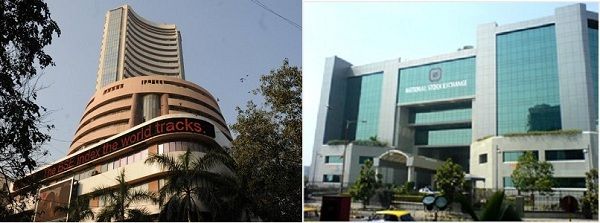 |
| BSE & NSE |
Features of Stock Exchange
(i)It is a place where securities issued by companies,government and other authorities are purchased and sold.
(ii) Its area of operation or geographical jurisdiction is well defined.
(iii) Its purpose is to assist and regulate buying and selling in securities.
(iv) It operates as per rules and guidelines issued by the Securities and Exchange Board
of India (SEBI).
Stock Exchange Functions :-
Providing Liquidity to Securities. Stock exchange provides a ready market for the
securities issued by various institutions.The investors can convert their money into
securities and vice versa very quickly. In other words, stock exchange ensures increased
liquidity of the
securities. This attracts people who have surplus money even for a short
period ot time to invest in stock market securities.
Services to Investors
1. Stock exchange safeguards the interests of the investors. The brokers can't cheat the
investors.
2. It provides liquidity of investments by providing a continuous market in shares and
debentures.
3. Securities can be sold or bought easily and can be used as collateral security for loans.
4. Price quotations of stock exchange help the investors to know the market value of their investments.
5. The investors are saved from the risk of investment in unsound companies because of the availability of adequate information
6. Clearing House of Business Information. Having listed the securities of most of the companies, a stock exchange serves as a medium of business intelligence. General economic and business trends disseminate from stock exchange influencing the decision- making process of companies.
7. Barometer of Progress. Stock exchange acts as a barometer of the business conditions
in the country. Booms and depressions are reflected by the index of prices of various
securities maintained by the stock exchange. One can easily analyse the causes of change
in the business climate by the ups and downs on the stock exchange.
The trend of security price index movements gives a fair indication of the state of the
economy, industry and trade. That is why the stock exchange is said to be a barometer of the
economy. Just as readings on a barometer reflect the atmospheric pressure and changes therefrom, stock market quotations of security-prices give an idea about the economic conditions of a country.
Stock Exchanges in India
Under the Securities Contracts(Regulation) Act, 1956, only the stock exchange recognised by the Central Goverment can operate. Further the regional jurisdicaion of each stock exchange is also laid down.
In addition, there are the National Stock Exchange (Mumbai) and the Bombay Stock Exchange. The BSE is also known as Dalal Street. These are main stock exchange in India.
Features of NSE and BSE:-
1. Ringless. The NSEI and BSEI are ringless stock exchanges, that is, there is no trading
hall in the stock exchange for buying and selling. Trading in securities takes place
through network of computers. The computers of local dealers of NSEI and BSEI are
connected to the control computers of NSEI and BSEI respectively through satellite link-up
2. Screen-based Trading. All transactions on NSEI and BSEI are electronically conducted
and trading is fully computerised. The buying and selling of securities can be seen on
the screen.
3. Transparency. The NSEI and BSEI are screen-based and so the investors can check
the exact price at which the securities are bought and sold. The brokers cannot indulge
in unfair practice of price manipulation. Screen based dealings ensure them fair dealings.
4. Incorporated Entities. The BSEI and NSEI are established as companies and are
promoted by financial institutions. Due to corporate form there is professionalism in
their functioning.
National Stock Exchange of India (NSEI)
The National Stock Exchange was set up by all-India financial institutions and commercial banks in November,1992. It started operations on July 1,1994 to provide countrywide screen-based and on-line trading facilities to investors. Its members can make transactions through their computer terminals which are linked with the central computer at the NSE. The main function of the NSEI is to provide the investors with nationwide trading facilities through electronic clearing and settlement system.
The National Stock Exchange occupies an important place in Indian securities market. It
has gained popularity because of the following services to the investors:
(i) The prices of various securities are available on the computer screen. The investors
can resort to trading in securities when they feel the prices are favourable to them
(ii) There is no fear of cheating by any stock broker. Date and time of the transaction are
indicated and there is transparency in deals.
(iii) Price and brokerage are separately shown on contract notes. There is no possibility of
overcharging of any commission.
(iv) Settlement and delivery are quick in the market.
(v) There is no problem of bad deliveries, loss, theft or forgery because securities are safe in a depository.
(vi) Effective regulation and monitoring of the system ensure a fair deal to the investsteps
TRADING PROCEDURE
Traditionally, trading on a stock exchange was done by the auction system. But now this
method has been replaced by online screen-based electronic trading system at all stock exchanges.
The system used by Bombay Stock Exchange is called BOLT, i.e., Bombay Online Trading System.
The procedure of purchase and sale of securities in a steps
1. Selection of Broker. A person intending to buy or sell securities must select a broker
who is a member of the stock exchange. The securities can be bought and sold only
through professional brokers only.
Earlier the member-brokers owned and managed the stock exchange which led to a
conflict of interest between the brokers and their clients. But now the stock exchanges
have been demutualised, i.e., ownership rights have been separated from the trading
rights of members
2. Placing the Order. After making the choice of a broker, a person will engage him for
buying or selling certain securities. Before placing an order, he can consult his friends
and the broker. The order can be communicated to the broker either personally or
through telephone, cell phone, e-mail, or online link,Now a days call trade or mobile app trade is famous.The instructions should specify
the name of securities to be bought or sold and price range within which the order is
to be executed.
3. Executing the Order. After receiving the order, the broker will contact other brokers
of the stock exchange and will give and receive offers to execute the order of his client.
When the deal is over, the broker and the other broker with whom he has entered into
the transaction will make brief notes of the price of their transactions in their diaries
After this, contract notes are prepared on the prescribed forms. A copy of the contract
note is sent to the client. The contract note contains the name and price of securities,
names of parties, brokerage charged and is signed by the broke
4. Settlement. This is the last stage in trading of securities done by the brokers on behalf
of their clients. The mode of settlement depends upon the nature of the contract. All
the transactions of the stock exchange may be classified into two categories, namely (a) delivery trade and (b) intraday trade.
* In delivery u can buy and sell shares when u want upto many years but in intraday u can buy and sell shares on same day till 3.10pm before market close.
Demat Accounts

An electronic book entry form of holding and transferring Securities has been introduced.This is called 'dematerialisation of Securities' and the buyer and sellers have to open account called 'Demat Accounts' with the broker institution to facilitate transfer of Securities bought and sold.

DEPOSITORY SERVICE AND DEMAT ACCOUNT Concept of Depository Service
A depository is a service organisation which holds securities in electronic form on behalf of the investors and facilitates transfer of securities between the buyers and the sellers.
The depository system functions very much like the banking system. A bank hold funds
in accounts of its customers whereas a depository holds securities in accounts of its clients. A
bank transfers funds between accounts whereas a depository transfers securities between
accounts. In both the systems, the transfer of funds or securities happens without the actual
handling of funds or securities. Both the banks and the depository are accountable for the safe
keeping of funds and securities respectively.
National Securities Depository Ltd. (NSDL) was the first depository in India to have
commenced operations in 1996. Initially, HDFC, ACC, Larsen & Toubro, TISCO, Reliance,
BPCL, CRISIL, Siemens and Hindustan Lever Ltd. had agreed to dematerialize their shares.
Dematerialisation is the process by which the physical certificates of an investor are taken back
by the company or its registrar and destroyed. An equal number of securities are credited to
the electronic holdings in a demat account of the investor.
CONCEPT OF Demat Account
Dematerialization ('Demat' in short form) refers to conversion of a security (e.g, share certificate)
from its physical form to electronic form at the request of the investor.
Dematerialization is a process by which the physical share certificates of an investor are taken back by the concerned company and equivalent number of securities are credited to the investors demat
account in electronic
form at the request ot the investor. An investor will have to first open an account with a Depository Participant (DP) and then request for the
dematerialization of his share certificates through the Depository Participant so that the
dematerialized holdings can be credited into that account. This is very similar to opening a
bank account.
SEBI has made it compulsory for investors to demat their shares if they wish to sell the
same through the stock exchanges. Similarly, if an investor wants to buy some shares, he will
get the delivery of the shares in demat form.
lf an investor wants to utilize the services offered by a Depository, he has to open an account with the depository through a Depository Participant. Thus, a Depository is just another form of custodial service, the difference being that the securities are held in an electronic form.
Moreover, the Depository can legally transfer beneficial ownership at the request of the demat accountholder which a custodian cannot.
The main objective of a Depository is to minimize paper work involved with the ownership, trading and transfer of securities.
SEBI

The 'SEBI' short for Securities and Exchange board of india is often in the news because of its supervisory and regulatory rule over the functioning of stock exchanges spread throughout the country. The SEBI has been set up as a statutory body under the SEBI Act, 1992
with a view: (i) to protect the interests of the investors in securities, (ii) to promote the
development of the securities market, and (iii) to regulate the functioning of the securities
market. In this section, we shall learn the functions and role of SEBI in the economy of our country.
The number of investors in securities in the country increased considerably during the
1980s. At the same time, several unfair practices were observed on the part of companies,
brokers, merchant bankers, investment advisers, etc. In order to protect the interests of investors,
the Central Government constituted the Securities and Exchange Board of India (SEBI) in
April 1988 under the administrative control of the Finance Ministry. Later, it became a statutory
body having perpetual succession and a common seal under the Securities and Exchange
Board of India Act, 1992.
Role of SEBI
The SEBI has been making endless efforts for the growth and smooth functioning of the Indian
capital market. It has also played a key role in the protection of investors. The role of SEBI
would be more clear by highlighting the steps it has taken over the years to implement its objectives. The major steps include the following:
(i) Registration of brokers and sub-brokers at the stock exchanges.
(ii) Registration and control of merchant bankers.
(iii) Regulation and control over mutual funds.
(iv) Regulation of insider trading.
(v) Issue of portfolio managers regulations
(vi)Issue of guidelines for disclosure and investor protection.
(vii) Issue of guidelines for the Governing Boards of stock exchanges..
(viii) Formation of advisory committees
for primary and secondary capital markets.
(ix) Launching of Stock Invest Scheme to eliminate delayed refunds.
(x) Check on misuse of promoters ' quota.
(xi) Issue of guidelines for free pricing of public issues.
(xii) Making rules for entry of foreign institutional investors.
(xiii) Issue of guidelines for floatation of public sector bonds.
(xiv) Launching of dematerialised (demat) trading in securities.
(xv) Formulation of take-over code.
To sum up, the SEBI has made impressive strides towards the fulfilment of its objectives.
It has initiated various measures including guidelines for disclosure and investor protection,
guidelines for investments by foreign institutional investors, guidelines for merchant bankers,
guidelines for mutual funds, guidelines on take-overs, etc. Thus, SEBI has emerged as the presiding body over the financial services sector in india
Broker. A broker acts as an intermediary on behalf of others. In other words, a broker is
a commission agent who transacts business in securities on behalf of non-members.He works for
commission and acts for a large number of clients.The services of a broker are extremely
useful to the ordinary investor who does not have the necessary skill or expertise for the purpose of buying or selling securities.For Ex.:-ZERODHA,UPSTOX,ANGEL BROKING,5PAISA,IIFL,Etc.
Opening a Demat Account:-
1. First of all,you have a Pan card and Aadhar card which is mandatory to open a demat Account.
2. There is 2 Depository Participant (DP) In India. (i) NSDL ( National Security Depository Ltd.) AND (ii) CDSL (Central Depository Security Ltd.)
3. You had already a saving Bank Account, if no then no problem Now a days Brokers also offers 3-in1 account i.e, Saving bank A/C, Demat A/C, Trading A/C, which is automaticaly open with Demat.
4. You have to 6 month Bank Statement, your photo & sign. which you have to upload.
5. Remember, you have your mobile number that is linked to your Aadhar no.
FOR OPENING A DEMAT ACCOUNT BELOW ARE REFERRAL LINK:-
https://youtu.be/NLjfr06E3j8. Hey there! I have been investing in stocks and mutual funds using the Upstox platform and am quite impressed! Upstox offers free equity delivery trades and you pay only up to Rs. 20 per order for Intraday, F&O, Currencies and Commodities. You get one of the best margins in the industry and access to a wide range of technical indicators and drawing tools. Join one of India’s fastest-growing broker. Sign up for a demat account now. https://upstox.com/open-demat-account/?f=5RHX&utm_source=refernearn&utm_medium=referral&landing_page=ReferAndEarn
Referral no.- AM8012 , Put this to get benefits while signup.

FOR MORE INFO AND ANY QUERY PLS.


कोई टिप्पणी नहीं:
एक टिप्पणी भेजें
Please do not enter any spam link in the comment box